Monday, February 23, 2015

The Libyan Martyrs: A Call to Martyrdom and Witness.

1 Cor 1:17-31

The Libyan Martyrs: A Call to Martyrdom and Witness.
A Homily Delivered at Evensong for Lent 1, 22 February, 2015


This month 21 men were martyred for the church.  

Their names were: 
Milad Makeen Zaky
Abanub Ayad Atiya
Maged Solaiman Shehata
Yusuf Shukry Yunan
Kirollos Shokry Fawzy
Bishoy Astafanus Kamel
Somaily Astafanus Kamel
Malak Ibrahim Sinweet
Tawadros Yusuf Tawadros
Girgis Milad Sinweet
Mina Fayez Aziz
Hany Abdelmesih Salib
Bishoy Adel Khalaf
Samuel Alham Wilson
Ezat Bishri Naseef
Loqa Nagaty
Gaber Munir Adly
Esam Badir Samir
Malak Farag Abram
Sameh Salah Faruq
and a worker from Awr village whose name remains unknown. 

These men were known Christians who had gone to Libya for work.  The so called Islamic State targeted them because they were Christians.  Their names were on a list because they were Christians. IS went and snatched them from their homes because they were Christians.  They took them to a beach on the Mediterranean Coast and then decapitated them because they were Christians.  The last words of many of them were Ya Rabbi Yasou “… O Lord Jesus.  

“For the Jews require a sign, and the Greeks seek after wisdom: But we
preach Christ crucified, unto the Jews a stumblingblock, and unto the Greeks foolishness…But God hath chosen the foolish things of the world to confound the wise; and God hath chosen the weak things of the world to confound the things which are mighty; And base things of the world, and things which are despised, hath God chosen, yea, and things which are not, to bring to nought things that are: That no flesh should glory in his presence.” (1 Cor 1:22-3, 27-9)

As I stand here in this beautiful stone pulpit, worked diligently and faithfully by the hands of skilled artisans, in vestments wrought by the handiwork of deeply faith Christians from South Philadelphia and England to Toungoo in Myanmar, in a gorgeous brick church with Tiffany stained glass and beautiful Marianne Sloane murals, with a painstakingly carved limestone altar under a beautiful slate roof that so many here gave graciously of their hard earned livelihood to install I can’t help but feel as if I am woefully, painfully unworthy to stand here and confess the Gospel of Christ. 

Unworthy though I am, I can hope only channel the words of St. Paul, and point to those who have witnessed to Christ in far greater and braver ways than I. 

We proclaim Christ crucified, a stumbling block to jews, and foolishness to the Greek.  But God chose what is foolish in the world to confound the wise.

Truth be told, I don’t know what is more foolish than proclaiming one’s faith in Christ as Lord just before execution.  It isn’t as though that was going to stop the demons from IS from going through with their grim mission.  It isn’t as though saying that was going to grant them some reprieve.  It isn’t as if they thought that would spare them from their fate. 

And yet cry out they did.  And we now have 21 new saints of the church, to shame the wise, to reduce to nothing things that are.  

IS is many things, evil springs to mind, awful, heinous, demonic in the most literal sense… But they are powerful.  They control a great deal of land, oil, money, and weapons.  They are quite mighty.  But God chose what is weak in the world to confound the mighty, God chose what is foolish to confound the wise. 

It isn’t as if we didn’t know prior to these martyrings that IS was evil.  But God chose what was weak not only to confound the mighty, but to inspire others.  The blood of the martyrs is the seed of the church, says Tertullian, and the witness these men provided, proclaiming Christ even to the point of death, strengthens me in my own considerable weakness.  If those men, regular men, people who left their homes in search of work and a better life, if those weak, powerless, expatriated men can heap shame and scorn upon those who are strong and mighty, then why can’t I?

For all the mysticism around martyrdom, it is simply the Greek word for witness.  We may not all be called to take up our cross in a way quite so literal as these men did, but we are all, each and every single person here, called to be a martyr, to be a witness to Christ in the world.  We are called to proclaim a God who lowered himself to the point of death, even death on a cross.  We are called to name sins, both our own and those of society around us.  We are called to be visibly Christian in the world.

If these men can stand for something for Christ in the face of death itself, why am I so reluctant to cause myself discomfort or inconvenience?  If these men are willing to be proudly Christian in a land where being Christian is risky, why do I catch myself referring to “graduate school” instead of seminary?  If these men are willing to die for their faith in a hostile land, why do I not shout from the rooftops the salvation of Christ in a land more friendly to the Christian faith than nearly any on earth? 

More than that, why do I not call to account the mighty, and the “wise” when they defy the laws of God?  Why do I not struggle mightily to hold to account our community and our nation when we fail to keep God’s commandments  to “do justice, love mercy, and walk humbly with God… to feed the poor, welcome the foreigner, clothe the naked, and visit the prisoners.”  My government will not kill me for being Christian, and yet I do not take the risks I know I should take. 

We need no more proof than this to know that St. Paul is speaking the truth when he says God chooses the weak and the foolish to confound and shame the mighty and wise.  Civis Romanus Sum, I am an American citizen, able to traverse the world knowing that my government and its most considerable might protect me. I live in the richest country on the planet, the most powerful state in history, and even my relatively humble life, by American Standards, would be a life of near unimaginable luxury to these men who went to Libya, a country torn by civil war and violence seeking work because their prospects at home were so bleak.  I am mighty, I am strong, and I stand here confounded and shamed by the witness of these men, these martyrs of the church. 

And what is even more shaming is the fact that it takes the martyrdom of these men to shame me when I know full well that there is one who has already been put to torture and martyred in ransom for my life, that it took this reminder to humble me when I celebrate at the altar each week the death and resurrection of our Lord.  That truth written nearly two thousand years ago is no less true today than it was when blessed Paul put his hand to that papyrus telling the church in Corinth that God will cast down the haughty so that those who glory may glory not in their own special, privileged place, not in their wealth, their power, their might, their wisdom, but in the Lord only.

Wednesday we began Lent by marking our heads with ashes, a symbol of repentance and of our own mortality.  To repent is to re-orient yourself towards God, to turn away from sin and temptation and to live more fully in the life into which God is calling you.  That there are people still dying for our faith is a reminder to me that there are many, many ways in which I need to repent, to reorient my life towards God, and I suspect the same is true for most people here.  I invite you therefore into a Holy Lent, that together we may confess and repent of all of our sins, that we may align ourselves with those who, in the name of God, confound the wise and the strong, and that, through our repentance and prayer, we may celebrate with joy the resurrection of our Lord and God’s final victory over sin and death. 

During this period of prayer and fasting, may we also give thanks to God for the lives and deaths of these 21 martyrs, these saints of the church, may we pray for their families, friends and loved ones, and may we pray for ourselves that we may better come to know Christ in order that we too may shame the wise and confound the mighty. 

And may their souls and the souls of all the faithful departed, through the mercy of God, rest in peace.


Thursday, February 5, 2015

Homily for the Martyrs of Japan

Martyrs of Japan
https://liturgyandmusic.files.wordpress.com/2011/02
/martyrs-of-japan1.jpg

The 1500s was a time of incredible change.  The world was expanding rapidly, people were interacting for the first time, and European powers were beginning to trade with places they’d never known of before.  East Asia, South Asia, the Americas: There was a whole new world out there.  
During time, Francis Xavier, one of the first Jesuits, and some others set off for Japan.   It was, at that time, fertile mission field.  The people of Japan were receptive to Christianity, and the Shogunate welcomed them. 

The Christian Missionaries were welcomed for a couple of reasons.  The Shogunate appreciated the trade benefits that the missionaries brought; allowing the missionaries into the country greased the skids a bit for trade with Spain and Portugal, which was something they wanted.  Additionally, the missionaries and the church provided a check on the Buddhist monks. 

When we think of Buddhists these days, we tend to think of people like the Dali Lama, or perhaps a middle-aged hippy Uncle with a soul patch who treks off to California occasionally to “find himself.”  In reality, they can be quite a force to be reckoned with.  Even today in Myanmar, there are always roughly the same number of Buddhist monks as there are men in the Army, and the two provide a check on each other, not just morally, but in force.  In past uprisings and unrest, it has been the monks that have lead the protests, and in some cases, brutal violence.  The Shogun was more than happy to let in someone who would help check and reduce their power.

Eventually, though, the Shogun started worrying about Imperialism, and he wasn't wrong.  The Spanish especially did tend to send Christian Missionaries into countries partially to undermine the power of the “pagan” governments so that they could come in and take control as the rightful Christian rulers.  Eventually, the Shogunate found a trade ship with some arms on it, which was not kindly received.  They reacted,  well… poorly.  They cracked down on Christians, culminating in a battle where 30, 000 Christians faced off against 100,000 Samurai.  Though there was a great cost to the government, the Christians were crushed.

Japan sealed their borders, and effectively cut off in the early 1600s, and they would not open for more than 200 years.

The thing is, there were still many, many Christians in Japan.  And those Christians needed priests.  And Jesus called us to preach the Gospel in all parts of the world. 
And so priests snuck in and were smuggled in to provide sacramental ministry to the Christians who were in Japan.  Both those martyred at the beginning of the genocide and those who were caught during it faced horrific fates.  

On February 5th, 1597, twenty-six Christians were crucified in Nagasaki.  They were the first of thousands to be killed.  Wives and children of those who were martyred were also ordered to be killed. 

A ships captain who helped sneak two priests into the country who was himself Christian was caught and sentenced to be burned.  He preached on the scaffold before his execution and was ordered to stop.  He asked what greater pain they could inflict on him than they were already, and he continued to preach even as he burned.  His body and those of his officers who met the same fate were left for days where they were.  Christians tried to come and venerate the bodies and take relics, and they were beaten severely. 

Christians were crucified. They were hung upside down into cesspits with slits cut into their foreheads to relieve the pressure in their heads.  They were tied naked to stakes as the tide came in, left to either drown or freeze to death.  Many went to their death singing hymns of praise, on their way to paradise. 

Priest captured would be put where they could hear and see their flock captured with them.  If they did not recant and apostasize, their flock would be tortured and executed in front of them until they did.  Rather than torture and inflict pain, Christians were made to bear the suffering of others, taking on responsibility for the suffering and death of those they loved, a story as old as Christianity itself. 
The whole nation was divided into groups of three families.  If one family was found to be Christian and they were not turned in by o
ne of the two families they were paired with, all three families would be tortured and killed. 

There has perhaps at no point since the death of Christ, including during the Diocletian persecutions or the persecution of Nero, been a time when Christians were more literally forced to take up their cross and follow.  When we pray that God regard not our sins but the faith of the church, this is the faith to which we can only hope to attain. 

This faith in a good and loving God, and incarnate God, a God awash in love in the person of Jesus is all the more remarkable for allowing itself to be proclaimed in the face of forces that can only be described as satanic.

A comparable analogue today would be if priests were sneaking into Nineveh in territory controlled by the Islamic State and were ministering to the Christians there.  The threat they would be under is similar, and the need for Christian witness would be similar. That is the gravity of the situation in which these Christians found themselves. 

And yet, the faith continued.  The light of Christ was not extinguished.  When Japan opened its borders nearly 200 years after sealing itself off, families were found that had crosses and crucifixes carved into the back of their Buddha statues.  

And though there are nearly three times as many Catholics today in Philly as in Japan.  More Catholics in Philly than there are Christians of any stripe in Japan.  There are still Christians in Japan.   Even those forces of Darkness could not be overcome by the forces of Christ.
Though the teachings were imperfect, having been handed down for generations without access to training or clergy, the faith continued, the traditions were passed down, and the church did not fail.

The Persecution in Japan was the most successful, and it forced nearly all Christians to take up their cross and follow, but even in the face of that success, Christianity endured. 

We will never be asked to take up our cross like the martyrs of Japan.  We’ll never be asked to suffer in the same way they did.  But we can draw our inspiration from them, we can remember their witness during our own difficulty, we can be brave enough to share the Gospel with those we encounter.  We can strive to witness as they did.  And by doing so, we can honor the sacrifices they made while tied to stakes, awash in seawater, amidst the flames, hanging in cesspits, and bearing the suffering of others.


May we have even a portion of the bravery and faith those brave men and women had, to give up our lives, take up our crosses, and follow the risen Christ. 

Wednesday, January 28, 2015

A Brief Homily on the Feast of St. Thomas Aquinas

http://tinyurl.com/lc5v836  
Today is the feast of St. Thomas Aquinas, a Dominican Friar and Priest.  St. Thomas is one of the most influential writers in church history, known as the Doctor Angelicus of the church, and much of our modern philosophy was developed either in conversation or opposition to what Thomas wrote.  It is, I think, very difficult to overestimate the impact Thomas’ writings had on the church.  He is best known for his books the Summa Theologica and the Summa contra Gentiles.  Impressively, his writings were declared whole cloth to be those of the Church, which, when you think about it is an incredible statement.  In what is perhaps the most telling testament to St. Thomas’ wisdom, he was once visited by the Blessed Virgin, to whom Dominicans have a particular devotion, their founder having apparently received the first rosary from St. Mary herself, and she was comforting Thomas with the welcome news that he would never be a Bishop.  

Having read a fair amount of the two Summas I can say, Thomas is a force to be reckoned with.  He writes powerfully and convincingly on the nature of the sacraments, on what happens at the Eucharist, on why we believe what we believe, and his writings have greatly influenced me, especially on my theology of the Eucharist.  In fact, in seminary when taking a liturgics class, I was reading an assignment that was making a particular argument about what actually happens during the canon of the mass, what happens when the priest at the altar is saying and doing certain things.  I have to admit, I didn’t find the argument to be terribly persuasive.  I noticed however, that it had cited St. Thomas’ a couple of times and so I went and read the document that this particular article was arguing against.  Given what I’ve said so far, I don’t think it will be any surprise that after reading through both, I found Thomas’ 750 year old argument to be quite a bit more persuasive than the article written in the last decade.  Even giving someone a three-quarters of a millennium advantage in additional scholarship, Thomas is still an opponent that’s difficult to beat.

And this is actually relevant, because for Thomas, God was knowable by reason.  There’s a joke going around the Episcopal Church that I’ve never been particularly fond of that says “The good thing about being Episcopalian is that you don’t have to check your brain at the door.”  I’d say that by virtue of being a faithful Christian is that you don’t have to check your brain, we certainly have no monopoly, and others certainly have great scholars, but St. Thomas is proof of that par exemplar. He believed deeply that our reasoning intellect that humans alone seem to have been given was given to us for a purpose, and that if God is true, we can learn about the nature of God through statements that must be true.  He teased and toiled those truths out of the world around us, out of our sacred texts, and out of lived experience.  And in doing so Thomas taught us more about the nature of God than perhaps anyone since the end of the Apostolic age.  His writings on God were so incredible and impressive that when his canonization trial was taking place to determine whether he’d be a saint the Devil’s Advocate pointed out he had no miracles (sainthood requires two, unless martyred, then only one).  The reply came: "there are as many miracles (in his life) as articles (in his Summa)", thousands.


And yet, Thomas never lost his reverence for mystery, knowing that even given our powerful intellect and our ability to reason out things about the nature of God, that God is, in the end, beyond our comprehension.  It was from this place of adoration and mystery that Thomas wrote communion hymns, many of which we still use today.  In fact, I believe the only hymn used at both of my ordinations was written by him.   
Humbly I adore thee, Verity unseen,
who thy glory hidest  ‘neath these shadows mean;
lo, to thee surrendered, my whole heart is bowed,
tranced as it beholds thee, shrined within the cloud.

Taste and touch and vision to discern thee fail;
faith, that comes by hearing, pierces through the veil.
I believe whate’er the Son of God hath told;
what the Truth hath spoken, that for truth I hold.

O memorial wondrous of the Lord’s own death;
living Bread that givest all thy creatures breath,
grant my spirit ever by thy life may live,
to my taste thy sweetness never failing give.

Jesus, whom now hidden, I by faith behold,
what my soul doth long for, that thy word foretold;
face to face thy splendor, I at last shall see,
in the glorious vision, blessed Lord, of thee.

As he approached the end of his life and knew he was dying, Thomas had a vision. Meditating before an icon, the crucified Christ said to Thomas, "You have written well of me, Thomas. What reward would you have for your labor?" Thomas responded, "Nothing but you, Lord." After this exchange something happened, but Thomas never spoke of it or wrote it down. Because of what he saw, he abandoned his routine and refused to continue dictation to the person helping him, Reginald of Piperno. When Reginald begged him to get back to work, Thomas replied: "Reginald, I cannot, because all that I have written seems like straw to me"


His monumental works stand as mountains in the church, the basis for much of our understanding of God, but to Thomas, compared to even a glimpse of Christ, they are but so much straw.  Such is the glory of God, that even those who understand better than most are still reduced to humble awe in the presence of Holy Divinity. 

The motto of the Dominican Order is, translated from Latin, to Praise, to Bless, to Preach.  St. 
Thomas did all of these things with exceptional ability.  He wrote well of Christ.  He, in his humility, loved God well.  May we all be so fortunate as to seek to know God to the best of our ability, to Praise God with our Work, to Bless God with our lives, and to Preach both the reasonable and mysterious glory of God.  And let us today give thanks for the life and work of Saint Thomas Aquinas, that we may one day humbly adore the God who dwells in light alongside him.

Friday, December 26, 2014

Let It Be Done Unto Me According To Thy Word.

2 Samuel 7:1-11, 16Canticle 15 
Romans 16: 25-27

A Sermon Delivered on Advent IV, 2014 at St. Thomas' Church, Whitemarsh, PA. 


Behold the handmaid of the Lord!
Let it be done unto me according to thy word!

Hail Mary, full of grace, the Lord is with thee.  Blessed art thou amongst women, and blessed is the fruit of thy womb, Jesus. 
Holy Mary, Mother of God pray for us sinners now and at the hour of our death. 


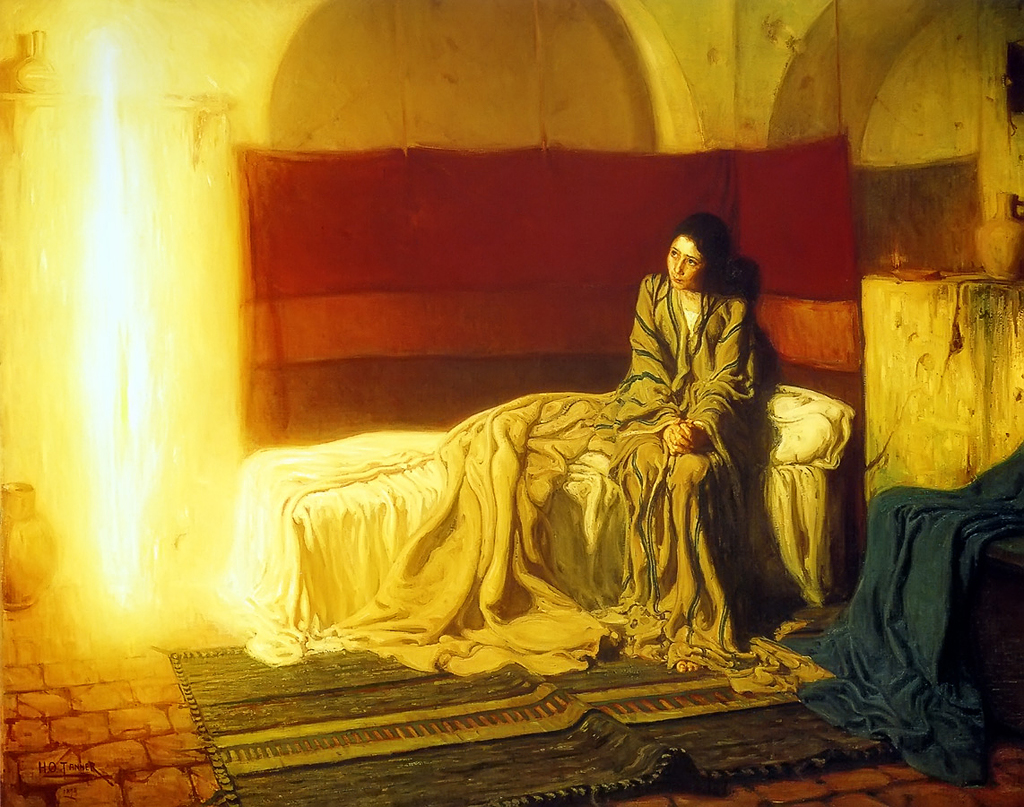
"Annunciation" By Henry Ossawa Tanner
Philadelphia Museum of Art
Over time many millions of faithful people have begun their day with those words at the sounding of the church bells, as people pray the Angelus with the chiming in of the morning.    

And yet it seems we have, at times, a fraught relationship with the Virgin Mary.  So many of us struggle with who she was, what she means, and how she has been perhaps misused over time, by both Protestant and Catholic alike.  

So who exactly is Mary, and why is she so important?  We don’t after all, celebrate the birthday of First Mother Mary Ball Washington, or have a holiday for the feast of St. Francis’ mother. Giving birth to a child and surviving the ordeal, particularly at that time, is certainly a miracle, but it’s not really the kind of miracle that usually gets one regarded as the second most important person of the New Testament, behind the Christ himself.
But there is more to the Blessed Virgin than that, and more she has to offer than simply being the theotokos, the God-bearer.

Let’s think back briefly to Abraham and Isaac.  God created a covenant with Abraham, promising to be faithful to him and his children forever.  God, testing Abraham, making sure he would be as faithful to God as God was to him, asked Abraham to sacrifice his son, his only son, whom he loved.  You recall that Abraham did not withhold even his own son, but God stayed his hand, sparing Isaac.  And Abraham’s faith had been reckoned to him as righteousness. 

But though God stilled Abraham’s hand, he did not stay Pilate’s.  But it was not Pilate’s Child that had been condemned.  It was God’s own.

And a sword pierced God’s own heart also. 

But though it was the Son of God who died, it was not the Lord only who lost a child on that fell day.  In fact, no matter how shattered and heartbroken Mary Magdalene, Peter, and John may have been, there was only one other who lost an innocent child. 

And it strikes me (as one so newly priested) that on that day Mary stood at the foot of the cross just as the high priest would stand at the altar in the temple. And better than any other of our order could she offer her sacrifice for the good of the world saying: “This is my body.  This is my blood.” 

And we know the benefit of that sacrifice, for by it God redeemed us and the whole of his creation, for we celebrate it again and again every week.  But it came at great cost, not only to God in the person of Jesus, but to the person who carried the Christ within her body for nine months, to the one who brought forth into the world through her straining and gasping and her desperate and bloody work the holy divinity of our Lord, the fullness of God enrobed in flesh, enrobed in her flesh. 

And I get the feeling that when Gabriel cried out “Χαῖρε, Ave, Hail!” that Mary didn’t imagine she would wind up standing on Golgotha at the foot of a cross. 

But she did.  And she did because of her grace-filled submission to God.  “Behold, the handmaid of the Lord, let it be done unto me according to thy word.”   I can’t help but think that someone must have taught Jesus to say in all things “thy will be done on earth as it is in Heaven.”

But we do not only venerate the Blessed Virgin for feeling the pain of the loss of a child, for that pain is far, far, too common in our world and there is not one single romantic thing about it.  We don’t venerate her for teaching her child well, because truth be told, I have to think raising Jesus was probably a relatively easy task, at least compared to raising, I don't know, someone like me. 

No, we hold up Mary because when an archangel appeared in her room crying “Hail, Mary,” her response was “let it be done unto me according to thy word.”  Regardless of cost, let it be done; regardless of pain, let it be done; regardless of difficulty, let it be done.  

And oh, how we need the Lord’s will done.  You’ve heard over the last three weeks all three of your clergy and our Bishop address from this pulpit the painful happenings around our country.  And Lord knows, all of us would much rather be talking about cute babies and oxen and donkeys.  And yet this morning the families of Officers Liu and Ramos in New York City are waking up four days before Christmas unconcerned with presents or tree trimmings because their loved ones have been taken from them, shot without warning or opportunity for defense.     

Only minutes up the road, an entire family has been killed, and even that incomprehensible tragedy has been pushed out of the headlines by other terrible news.  
This is why it is why Our Lady is perhaps more important now than she has been in a very long time.  Because violence is what happens when we impose our will by force.  Violence is what happens when we decide that we should be the ultimate arbiter of justice.  Violence is what happens when we in our limited, clouded, imperfect judgement decide we are worthy to usurp God’s will and supplant it with our own. 

Violence is what happens when we fail to say “Behold the servant of the Lord!  Let it be done unto me according to thy word.”  Let thy will be done.  Not my will.  Not my will.  But your will.  Your peaceful will, your sacrificial will, your loving will, your redeeming will. Your will where the proud are scattered in their conceit.  Your will where the mighty are cast down from their thrones and the lowly are lifted up, your will where the hungry are filled with good things, your will where you remember your promise of mercy.  

We need Mary because we need a reminder of the beauty of holiness, of the good that comes when we submit to God’s will.  We need the example and the prayers of the Queen of Heaven, clothed with the sun, with the moon under her feet and a crown of twelve stars on her head, the one who brought Christ into the world because we so desperately, desperately need Christ brought back into the world again. We need the power of God to overshadow us. 

We need her example so that we might look at Christ in the same way and with the same love she did, loving Christ and his teachings as a mother loves her children, as any parent loves their children.  We need her because we need to see God not only as the one enthroned in heaven surrounded by the elders and the tribes and the martyrs, but among us and amidst us in the blood and flesh and grime and dirt and hay and the humanity all around us.  Because it is only in our recognition of the incarnation of God here with us that we can understand what God’s will is.  And it is only then that we can truly pray for God’s will to be done. 

So this year more than most I find myself celebrating not just the beatific scene of Mary serenely smiling and holding her beautiful, cooing newborn, but the strain and pain and effort Mary undertook to wring out of her own body the presence of God, and aspiring myself to reflect that, and to take this new year to more frequently say: “let it be unto me according to thy word.”

Pray for us, O Holy Mother of God. 
That we may be made worth of the promises of Christ.

Wednesday, August 6, 2014

Sermon on the Feast of the Transfiguration

The Transfiguration of our Lord
Source: http://www.stjohnsepiscopal.com
A blessed feast of the Transfiguration to you!  Today we commemorate the day in which Jesus and Peter and James and John went up on a mountain and there they glimpsed Jesus’ true nature.  They saw that Jesus’ appearance had been altered. 

They’d seen him do great things, but until now, Jesus probably looked pretty much like just about every other 1st century middle-eastern Jewish man.  But this time, he looked…  different.

When they saw him this time, though, there was more there.  He was talking, with Moses and Elijah.  Talking about exodus, about departure.  

But not only were Moses and Elijah there, his clothes had changed.  He looked the same way the scriptures described Moses as looking when he came down off of the mountain.  He looked radiant, full of glory, as of the father’s only son. 

And then there was the voice.  That voice had been heard before, but not by Peter and John.  It had been heard at Jesus’ Baptism.  “This is my Son, my Chosen; listen to him!”  Standing there with the radiant Christ, John and James and Peter heard the holy theophany, the very voice of God, telling them, actually the voice of God, telling them, that the rabbi they have been following is not just a rabbi, not just a prophet, but the Son of the Divinity that set all things into being.


Today is an important day because it is a day where we get a special glimpse of just how different this Jesus is.  Because, and I don’t want to sound too heretical, but it’s important because if we put ourselves in the disciples place, they don’t know what he is yet yet.  We have the benefit of hindsight, we have the benefit of knowing how the story ends.  We know, like Desmond Tutu says, that we shouldn’t get discouraged.  We’ve read the end of the book.  We win!  We know this.  

But Peter and Andrew, and John, and Thomas, and James, and the other seven apostles, don’t know this.  They've been following this guy.  And they know he’s different.  

But healing someone doesn't make you the messiah.  Curing the lame doesn't make you the messiah.  Telling people you can forgive their sins doesn't make you the messiah. 

And come to that, being the messiah doesn't necessarily make you the son of God.  These guys know that Jesus is special.  He’s different. They’re sure he’s a prophet.  They know that he has something to teach about God, and Peter’s already convinced that he’s the Messiah.  But even so, this prophet of theirs is headed to Jerusalem.  And they know what happens in Jerusalem as well as anyone else.  It ain’t good.  Not for the followers, and definitely not for the prophets. 

But this experience throws a bit of a wrench into the works.  They’d signed up to follow a prophet, but now they see Jesus in a new light.  A radiant light.  And he’s standing there, full of glory, the glory as of a father’s only son.  And this holy theophany rocks them to the core of their being… “This is my son.”


And there standing before them is the son of God.  God physically present among them.  


Just like it’s hard for us to sometimes remember how differently things looked to the disciples, because like Bishop Tutu says, we know how it ends, it’s hard for us sometimes to remember just how incredible this transfiguration is. 

We know that Jesus is the son of God, that Jesus is God, but while we perhaps shouldn't be surprised, we should be every bit as overawed as Peter by this fact.  And we should be this overawed every time we come before the altar to celebrate the last supper, because a transfiguration every bit as miraculous occur at the mass. 

On the mountain, it was revealed to Peter and John that the son of God was physically standing before them.  And even more incredibly, we get to experience the same thing!  We don’t get to hear the holy theophany each week, or to see Moses and Elijah discussing exodus with Jesus, but Jesus will be every single bit as present in the host at the Eucharist as he was on that mountain.  

I think it’s easy for us to think of Eucharist as our shared meal.  And it is.  It certainly is that.  But it is also so much more.  It is through the Eucharist that we commune not only with each other, but with God in Christ.  It is through the Eucharist that Christ is made physically present to the community, that God’s faithfulness is demonstrated.  It is through the Eucharist that we join Peter and John on that mountainside, overcome by the voice ringing out almost beyond comprehension, stunned that the man we are following is so much more than we thought he was.  It is through the Eucharist that the veil between heaven and earth is torn, when “This is my Body” and “This is my blood” don’t just bring Christ to us, they elevate us to the heavenly realm where we stand amid the crowned martyrs and the choirs of angels and the crystal sea and the elders before the throne, just as present with Christ as Peter and John.  

So today, on this Feast of the Transfiguration, take a moment to marvel at the presence of the glorified Christ with us in this room.  Let the veil tear, let the verity unseen radiate throughout your being, recognize the wonder of standing in the sanctuary in the very presence of God. 

Then, come, take, and eat, and drink, and allow the glory of Christ to shine in you, that together we may become the glorified body of the risen lord right here on earth. 

In the name of the Father and of the Son and of the Holy Spirit.  Amen

Saturday, April 19, 2014

Good Friday Meditation

Meditation for Good Friday
St. Mark's Episcopal Church, Alexandria Va, 
18 April, 2014


So the reading for Good Friday is traditionally from the Gospel of John, but there is a portion of St. Matthew’s account of the crucifixion that has gotten a hold of me, that has intrigued me for a long time.  

Matthew 27:50   

Then Jesus cried again with a loud voice and breathed his last. At that moment the curtain of the temple was torn in two, from top to bottom. The earth shook, and the rocks were split. 


A week ago Jesus said if his disciples were silent that even the stones would cry out.  And now the anointed one, the promised one, the savior to whom sweet Hosannas rang hangs here, abandoned. 

Nails through his hands and feet.  

A crown of thorns jammed into his head. 

His back scourged, whipped until much of the skin had been taken off.  

And a spear shoved through his side. 

The sky went dark, even the sun refused to shine.  

And his disciples had gone silent, and the stones cried out and were rent in two. 


And there on the cross God himself hung.    Dead. 

And the curtain in the Temple was torn in two, from top to bottom. 


The curtain in the Temple separated the Holy Area from the Holy of Holies, from the Mercy Seat of God.  This was the dwelling place of God, this was literally God’s house.  

And at the moment Jesus died, God’s home was destroyed. 

From that moment on, God no longer lived in the Temple, on Zion.  God no longer dwelled between the Cherubim above the Ark of the Covenant. 


Many Biblical scholars believe that this tearing of the curtain symbolizes God breaking into the world.  But I’d say God had already done that.  God had done that thirty some years prior when Jesus was born to the Blessed Virgin Mary. 
They have said that since the Holy of Holies was considered to be like Heaven, that the tearing of the fabric marked a destruction of what kept humans apart from heaven, what kept us separated from God.  


I beg to differ.  

At least somewhat. 

I think all of that is true, or at least it became true with the resurrection of Christ.  But at this point, Jesus is still dead.  God is still nailed to the hard wood of the cross dead.  Jesus was gone.  Though we know how it turns out, The victory had not yet been won. 

God had been killed on the cross.  God’s home had been destroyed.  And for roughly 36 hours God was not in the world.  

We hear “God is dead” quite a bit.  But have you ever stopped to ponder what it was like in Jerusalem in a moment where that was actually true?

 After an earthquake and the sky going dark, even the folks that had not witnessed the execution of Jesus outside the city walls had to know something was up.  Did folks go about their business as if nothing had happened?  Did they whisper and gossip in dark corners about the mysterious occurrences.  Were they subdued, either wary of the signs that had occurred or satisfied with the “Justice” they had gotten from Pilate?  Did they go around with a nagging feeling that something was out of place, that something was not right, that something was missing? 

Did they know when they prayed, that during that one day, out of the entirety of human history, did they know that day when they prayed that there was no God to hear them?  

This is not to say God had ceased to be.  On the contrary we believe that Christ had descended to the dead and was harrowing hell.  But Jesus was not with the living, he was with the dead.  

And God’s home was destroyed.  Yes, this does mean that God is done dwelling there, and that the grace of God, held back by the curtains, held back in the temple, held back by the law… that the grace of God would pour out into all the world when Christ came back. 

But today we are standing here with a cross draped in black.  We’re standing here with an altar stripped down to bare wood.  We’re standing here with the tabernacle left open with nothing in it.  We’re standing here on Good Friday, not Easter Sunday. 


I wonder, on that day, was there more crime?  Did people resort to more extreme measures to defend themselves?  Was there an uncertain fear, an unease sitting on the hearts of those in the Holy City? Was everything to everyone just slightly off, like a photo that’s just a few degrees off, skewed enough to distract the eye,. 

I wonder if even the devout prayed and felt nothing. 

We will soon enough find ourselves caught up in the joy of Easter.  We will don white and we will shout Alleluias for the first time in a month and a half and we will cover the church in flowers and splendor.  We will celebrate Christ’s victory over the death that he suffers this day.  

And it will be easy in the midst of such joy and celebration to forget this moment.  It will be easy to forget what that victory cost.  It will be easy to forget the pain, the anguish, the suffering, the devastation.  It will be easy to forget the brutal pain inflicted on his broken body.  It will be easy to forget “My God, My God, why have you forsaken me?” 

And it’s true, we don’t want to dwell only on Good Friday, for our story does not end here. 

But this is a feeling we need to make the celebration meaningful.  Cheap victories are easily forgotten.  

For the next 36 hours, rend your hearts, put yourself at the foot of the cross.  Imagine a world that has lost it’s meaning.  Imagine life with no animating force, imagine how it must have been to cry out on that fell day and to hear nothing, to cry out on that fell day and hear nothing.   Imagine a world in which love itself has died.   Weep tears of pain and sorrow and suffering.  Weep for the Son of Man, turned on and destroyed by men.  Veil yourself as the sky, cry out in despair with the stones.    

Allow yourself to feel all there is that makes this our darkest day.  


And Sunday, when you awake, and you come to the tomb and find it empty, watch as the mountains of despair, and lament and pain are taken from you and thrown into the sea by the one who appears before you today in weakness nailed to a cross, but who will return triumphant in Radiant Glory.  

Monday, September 30, 2013

On Shutdowns, Food Stamps, and... Musicals?

Sermon delivered at St. Mark's Episcopal Church in Alexandria, Va on the eve of the 2013 government shutdown.

Readings for the day: http://www.lectionarypage.net/YearC_RCL/Pentecost/CProp21_RCL.html


May I speak to you in the name of one God, Father, Son, and Holy Spirit.  Amen


I will unabashedly admit that I appreciate musical theatre.  I’m not a particular fanatic, but I do, on occasion, thoroughly enjoy a show where the acting and the story are supplemented by the type of emotional amplification that only music can provide.  In fact, when Lara and I went on our first date, it was to see Beauty and the Beast when it was re-released in theaters.  I played in the pit orchestra for four different shows when I was in school.  When I was little, my sister and I would stage epic wars after going to see Les Miserables (it’s still one of my all time works of art).

Last year, on the Feast of the Nativity of our Lord Jesus Christ,  The feast of His birth, on Christmas Day, perhaps the second holiest day of the year, I not only went to church, but went with my family to see the new cinematic version of Les Mis.  (For the record, I thoroughly enjoyed it, and though there were a few bumps I would highly recommend the movie.  If you haven’t seen it redbox it or rent it tonight.  Sorry, ‘skins fans, but it doesn’t look like that game is gonna be worth watching anyway.  Take it from a Panthers fan, I should know.)

Back to musicals though.  The thing that always bothered me about them was this: if you are walking through the grocery store and someone breaks out into song rather randomly in your aisle, you’re probably going to think they are crazy.  I mean, even if I heard a bunch of music coming from seemingly nowhere, I’m not nearly a good enough dancer to jump in and take part in a completely spontaneous flash-mob style dance.

But that kind of stuff is something you have to take for granted in a show, something you accept as natural in some parallel world that looks very much like ours apart from a few musical interludes.  I mean, in our world, what could possibly cause us to break out into song at random intervals of the days.  Even if we were “fools for Christ” as we are exhorted to be, that might be just a bit too foolish.

Now, I think you all know how I feel about Paul.  As the second or third most important figure in Christianity, I think Paul gets a bit of a bad rap most of the time.  We are tempted to hold him to standards of our time, or to find him a moralizing, strident, and obnoxious person.  I’d like to posit that’s probably not the case.  Paul was by far the most successful of the apostles at evangelization.  He was an incredibly pastoral presence, to the point we are, to this day, still applying the advice and directions he offered to congregations in his time to our own congregation and faith community today.  In order to be that good, to make that many people want to follow him, to have that many people stick with him, remain loyal to him and to Christ even after he makes some really, really strong rebukes,  I mean, he must have had some charisma, he must have had some verve.  He had to be the kind of guy people wanted to be around.

Now this letter to Timothy is contested.  Some folks think it is a real letter from Paul, more think it probably isn’t a real letter from Paul.  But it does bear a bit of a Pauline hallmark.

It turns out our friend Paul has a rather odd habit.  Like Harold Hill or those spry teenagers on Glee, Paul occasionally will just break out into song.


At least he does in his letters, and I refuse to believe he didn’t also do that in real life, because it’s just too awesome, and it fits his character oh so well.

And when Paul does break out into song, it’s usually because it’s something pretty important.  Paul does this because he is overcome by the spirit, because happiness is shining out of him.  He does it because he can’t hold all of that amazement, and gratitude, and excitement, and joy, and love in his feeble little human heart.  He just can’t do it, and so the spirit pours out of him, his writing changes, his syntax and his style changes, he sometimes takes off on a glorious tangent and occasionally when he finishes he’ll drop in an “Amen” to let you know that he’s collected himself again. Then he resumes his tight and precise writing style and picks right back up.  So when you hear Paul doing this, pay attention, because it’s at these times most of all that the spirit is pouring through Paul and onto the page, telling us what we need to hear.

An excellent example, perhaps the prime example of this is in Philippians 2. where Paul says

5Let the same mind be in you that was* in Christ Jesus,
6 who, though he was in the form of God,
   did not regard equality with God
   as something to be exploited,
7 but emptied himself,
   taking the form of a slave,
   being born in human likeness.
And being found in human form,
8   he humbled himself
   and became obedient to the point of death—
   even death on a cross.

9 Therefore God also highly exalted him
   and gave him the name
   that is above every name,
10 so that at the name of Jesus
   every knee should bend,
   in heaven and on earth and under the earth,
11 and every tongue should confess
   that Jesus Christ is Lord,
   to the glory of God the Father.

And we see him use what may be another fragment of a hymn in today’s reading from Timothy:

He who is the blessed and only Sovereign, the King of kings, and Lord of Lord.  It is He alone who has immortality and dwells in an unapproachable light, whom no one has ever seen or can see; to him be honor and eternal dominion.  AMEN.


Now if Paul played for the Nationals, a: they’d still be playing next week because he can work miracles, but b: his walk-up music would be Amazing Grace.  Paul was a man who seemed to spend every moment of his life utterly and thoroughly aware of the Grace that he lived under.  And that’s a good message to hear when we get tough passages like today’s gospel, or today’s epistle, or for that matter many of the readings that we have heard over the last few weeks.

I’m not saying this in order to tell you that God doesn’t challenge us, that God doesn’t call us to an amendment of life.  God absolutely drives us to new life the same way Jesus was driven into the wilderness by the Spirit.  God pushes us in uncomfortable ways if we open our ears and listen.

If we listen, if we open our ears and hear what the Spirit is saying to God’s Church, we will hear God telling us that the love of money is the root of much evil, and that the love of money has driven many away from the faith in their eagerness to be rich.  We hear God tell us that the compulsive need to hoard cash the way some very sick people hoard empty soda cups and old newspapers, is disordered.

But we see many with the need to acquire more and more until life has been completely consumed not with doing justice and loving mercy and walking humbly with God, but gathering more and more to the detriment of both oneself and others.

 We hear God tell us to pray for our enemies, to beat our swords into plowshares, and we see a long history of Christian thought laying out a just war theory, a set of guidelines for those rare occasions when it might be acceptable to use force as a last result.

But we see over-reach, a lack of transparency, and an indiscriminate use of less discriminating weapons systems, such as unmanned arial vehicles.

If we look we see God point to those who are sick and suffering, those who are incapacitated, those who spend their lives begging to eat even the food that falls to the floor, the cast off scraps we toss out without thinking.

We see God pointing to someone laying at the gate of the rich man, trying to eek out three meals on $4 Dollars and .12 Cents worth of food stamps a day in the state of Virginia, less than the smoothie I had at Starbucks on Friday... we see God pointing to him or her and saying that person will rest in heaven with the pillars of the faith.

And we see the rich man, the man who couldn’t be bothered to throw Lazarus a scrap, the man who decided $4.12 a day to stop his impoverished neighbor and 3.8 million others from going completely hungry was simply too much to be bothered with, while he feasts nightly at fundraisers with other rich and powerful people.  We see him told that there is an uncrossable chasm, and we hear a warning that if someone ignores God’s commandments that thoroughly, that even a messenger coming back from the dead, even God’s Son coming back from the dead will not convince them to change their ways.


God challenges us weekly.  God challenges us daily, even hourly.  And if we don’t hear God challenging us, if we stop feeling that push, that prod, that tug, that strong yank on our spirit saying, “No.  Take another look at that.”  then we should probably try and spend some more time listening and a lot more time praying, because listening for God WILL make you uncomfortable.

So...      thoroughly convicted by God and the Spirit, it seems like we should be in trouble, right.

I mean, leaving the food stamp debate aside, worldwide we grow enough food to feed the whole world, but lose 50% in production between the farm and our plates, and we have people around the world starving.  If that’s where it ends, we are all, pardon my language, screwed.


And that’s why Paul keeps breaking into song.


Because that’s not where it ends.  Not even close.


God compels us, God pushes us, God sometimes pokes us really hard.  But God also forgives us.  And that’s why Paul sings.  Because he knows that the Jesus who told these parables has taken a look at us, known just how wrong we were, and decided to love us anyway.  He knows that God, immortal and dwelling in unapproachable light, Sovereign, King of kings, and Lord of Lords has sat in judgement, has found us wanting, and has decided to love us anyway.  He knows that God has chosen in his Son to pour out grace on us in spite of the fact that we so clearly don’t deserve it.

Amazing grace, how sweet the sound, indeed.


And so, as we go through these trials, we must know that the grace Paul saw even as he was warning and admonishing us, the grace Christ spoke of time and time again is there.  And these times are particularly trying.

Data may point to a recovery, and the market may be back up, but we have more people living in poverty than ever before, and that chasm of wealth continues to grow.  We have violence ripping apart our society, hitting particularly close to home less than two weeks ago in a rather non-descript office building full of civil servants, people not thanked nearly enough for the work they do to keep our country running, when a person with serious illness slaughtered people he had never even met.  We have the uncertainty, or at this point, the grim near-certainty of a government shutdown, a political football for some, but an event that will seriously hurt many people sitting right here today.  We have a lot going on.  And in the midst of it all, we still have to think of others.  God isn’t going to let us off the hook on that one.  We HAVE to try, and we can always do better than we are currently doing.

But even so, even more importantly, we have the grace and love that have been given to us by God, dwelling beyond our clouded sight.  We have that welcome, that warmth, and that hope.  We know that we are loved in this world, and welcomed home in the next.  We know that in spite of our shortcomings, our failings, our inadequacies... despite our loss, our despair, our worry, our fear, our brokenheartedness... despite all of that

We
Are  
Loved.    

We are loved, and we are redeemed.


It kinda makes me want to break out into song.

And I hope that at some point during this coming week, no matter what happens, good or bad, at work or shut down and labeled with that totally unfair term "non-essential," come what may....  I hope that love, that grace makes you want to break into song, too.

In the name of the Father, the Son, and the Holy Spirit.


Amen.